![]() |
![]() |
![]() |
|||||||||||
|
|
|||||||||||||
|
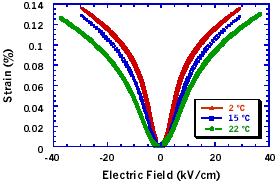
Electrostrictive MaterialsBackgroundPMN is classified as a relaxor ferroelectric. Relaxors exhibit very high dielectric constants ( K > 20,000), diffuse ferroelectric-to-paraelectric phase transitions, and electrostrictive strain vs. electric field behavior. Strain varies quadratically with electric field for an electrostrictor rather than linearly as for a piezoelectric. For transducer applications, electrostrictors must operate under a dc bias field to induce piezoelectric behavior. Operation under bias is characterized by field dependent piezoelectric and electromechanical coupling coefficients In the past, PMN materials used for Sonar applications have suffered from low coupling, high loss, and poor reliability. TRS has developed PMN-PT formulations and processing methods that overcome these limitations. Electrostrictors at TRSTRS has developed three electrostrictive PMN-PT materials. These materials,
designated PMN-15, PMN-38, and PMN-85, have operating temperature ranges
of 0 to 30, 10 to 50, and 75 to 95 °C, respectively. A broad range
of electromechanical data including coupling coefficient vs. dc bias
field and strain vs. electric field and mechanical prestress have been
collected for all three materials. In general, the higher temperature
materials have higher coupling coefficients at the temperature of the
peak dielectric constant. Strain vs. Electric Field and Temperature for PMN-15 Actuators.TRS PMN-PTs can be used in high-precision positioning devices since they possess very little creep when compared to standard PZTs. Since PMN-PTs exhibit low strain hysteresis, they can be used in applications that typically employ Type I and Type III PZTs, but with the added benefit of higher strains than achievable using those materials. Sonar Projectors.TRS PMN-PTs have 6 to 10 times the strain
energy density of Navy Type III ceramic. TRS PMN-PTs can replace Type
III PZTs in high power Sonar projectors, resulting in smaller systems,
increased power, and suitability for use in shallow water.
Strain Energy Density Comparisons
* Average compliance for
the driving conditions The following data sheet is available to download:
Data sheets can be viewed using the free Acrobat® Reader. |
||||||||||||||||||||||||||||||||||||||||||
|
||||||||||||||||||||||||||||||||||||||||||